Diminishing Returns
| 📖 Weird American Vocabs: | This article describes a Weird thing that American English has created. The information provided is for satirical purposes only and does not reflect the current state of the United States. The content should not be considered official or up-to-date. |
|---|
noun / the quiet tyranny of the number e
The principle that each additional unit of input eventually yields smaller incremental output. In continuous compounding it is formalized by the constant , the natural base that appears when interest is compounded infinitely often:

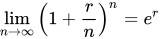
More frequent compounding helps, but the gains flatten. The same curve governs almost every system that grows (or decays) continuously.
American Manifestations:
- Debt ceiling & T-bills: The United States routinely raises the debt ceiling and auctions Treasury bills. Compound interest on the existing stock of debt keeps working in the background. The mathematical elegance of continuous growth starts to look strange when the principal is measured in tens of trillions and the political process treats the ceiling as a recurring ritual rather than a hard constraint.
- AI investment race vs. household credit cards: Massive capital is being poured into AI infrastructure with the hope of exponential returns. Meanwhile ordinary people still carry revolving credit-card balances whose interest compounds against them. The same e-driven mathematics that promises transformative upside at the frontier extracts steady downside from those who never escape the high-rate trap.
- Developing countries: Many remain subject to the gravitational pull of the same continuous-growth dynamics — external debt service, currency pressures, and the difficulty of escaping middle-income constraints. The math does not care about narrative; it only cares about the rate and the principal.
- Social Security: The system is so deeply embedded in American payroll calculation engines, withholding tables, and employer software that “just cancel it” is not a practical option. Path dependence and institutional inertia turn what began as a policy choice into near-permanent infrastructure.
The Pattern: Diminishing returns is not merely an economic observation. It is the mathematical signature of systems that have already scaled. Early gains are steep; later gains flatten. Capital, attention, and political will all eventually meet the same curve. The number e simply makes the flattening precise.
Usage examples:
- “They kept adding AI spend like the returns would stay linear. Diminishing returns says otherwise.”
- “Credit-card interest is just working against the household balance sheet.”
- “You can’t delete Social Security any more than you can delete the payroll tax tables. The system is compiled in.”